
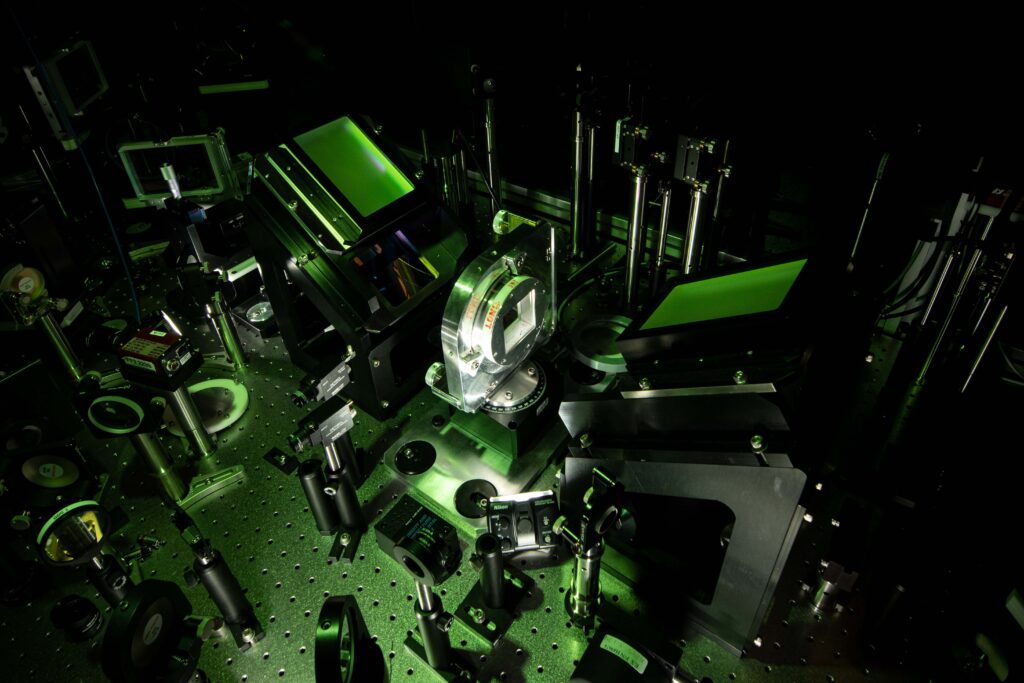
The technology at the heart of NSF OPAL has its roots in a discovery made decades ago at the Laboratory for Laser Energetics (LLE). Chirped-pulse amplification — the technique that enables ultrafast, high-power laser pulses — was developed at LLE, and later recognized with a share of the 2018 Nobel Prize in Physics. It now underpins laser systems across science, medicine, and industry worldwide.
NSF OPAL is where that lineage leads next. Designed to push laser energy and power into new experimental territory, NSF OPAL will give researchers access to the extreme physical conditions needed to test predictions of quantum electrodynamics, advance high-energy-density science — including the pressures found in the cores of giant planets — and to develop the optical materials and laser architectures that future high-power systems will require.
The broader story of how NSF-supported laser research shaped the modern world — from fiber-optic communications and LASIK to gravitational wave detection and semiconductor manufacturing — is one worth knowing. NSF recently published a detailed account of that history, and it’s a compelling read for anyone who wants to understand the scientific foundation NSF OPAL is built on.
Read the article from NSF: Lasers: The Power of Light