
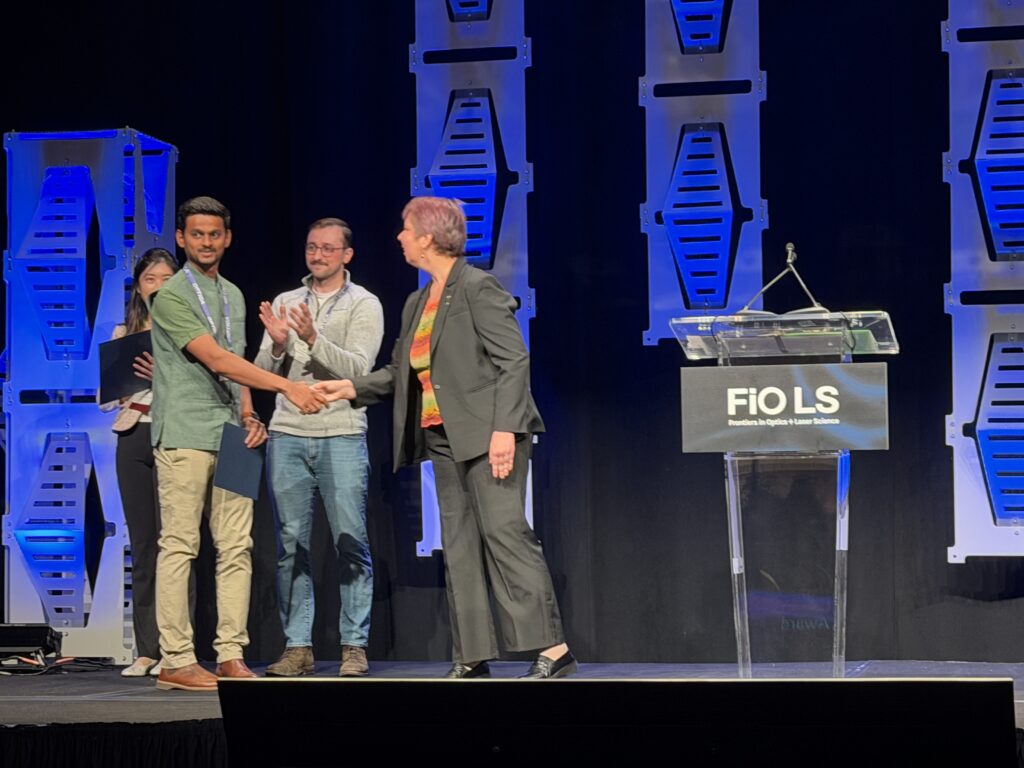
Congratulations to postdoctoral researcher Smrithan Ravichandran, who recently received the 2026 Carl E. Anderson Dissertation Award from the American Physical Society’s Division of Laser Science in recognition for his outstanding research in laser science. The award honors Ravichandran’s doctoral research during his graduate studies at the University of Maryland under the guidance of his advisor Wendell T. Hill, director of the Institute for Physical Science and Technology. His thesis, “Relativistic Electron Dynamics in Petawatt Laser Fields with Applications to Fundamental Measurements,” marks a significant contribution to the field of high-intensity laser science.
In recent years, advances in laser technology have enabled scientists to push the peak power capabilities of laser systems to unprecedented levels. Such lasers open up new realms of research and broaden current understanding of a variety of phenomena—from the extreme conditions and states of matter found only at the center of stars to the fluctuation of particles within the vacuum that makes up most of the universe. But, as Ravichandran says, “Using extremely powerful lasers as tools to make groundbreaking discoveries requires exquisite control of these laser fields. In order to control these fields the way we want, we need reliable knowledge of the conditions within the laser focus at full power.”
Current measurements of these conditions, however, rely on optical measurements made by sampling the field at low power since no material system would be able to withstand such high intensities of light—simply put, any detector in the laser focus would be burnt to a crisp. That’s where Ravichandran’s doctoral research comes in, which tackles some of the major challenges in measuring the fundamental properties of the quantum vacuum—one of the four flagship experiments being planned for the future NSF OPAL facility. In particular, Ravichandran’s work demonstrates that scientists can rely on the dynamics of electrons liberated from residual gas in the focal volume, which can interact with the field at full power, to potentially reverse-engineer the conditions within the laser focus. “This means that we can create novel diagnostics that will allow us to harness these extreme laser fields more efficiently to make groundbreaking discoveries,” he says.
Currently a postdoctoral researcher at the University of Rochester’s Laboratory for Laser Energetics (LLE), Ravichandran collaborated with LLE scientist Anthony Raymond, a member of the research group of Hans Rinderknecht, who is leading the quantum vacuum flagship on NSF OPAL. Together, Ravichandran worked with Raymond on two experimental campaigns at the MTW Laser Facility at the LLE, which played a critical role in demonstrating how electron dynamics can be useful to sampling laser aberrations.
Ravichandran also highlights the importance of cross-institutional research collaboration to his burgeoning success as a scientist: “One of the most enriching things about my doctoral work was being able to work with people from multiple laser facilities across different countries,” says Ravichandran. “Not only did this give me access to a wide network of experts in all aspects of conducting an experimental campaign, it also taught me to appreciate the nuances in working with people from different professional and personal backgrounds, due to the international collaborations my work often involved.”